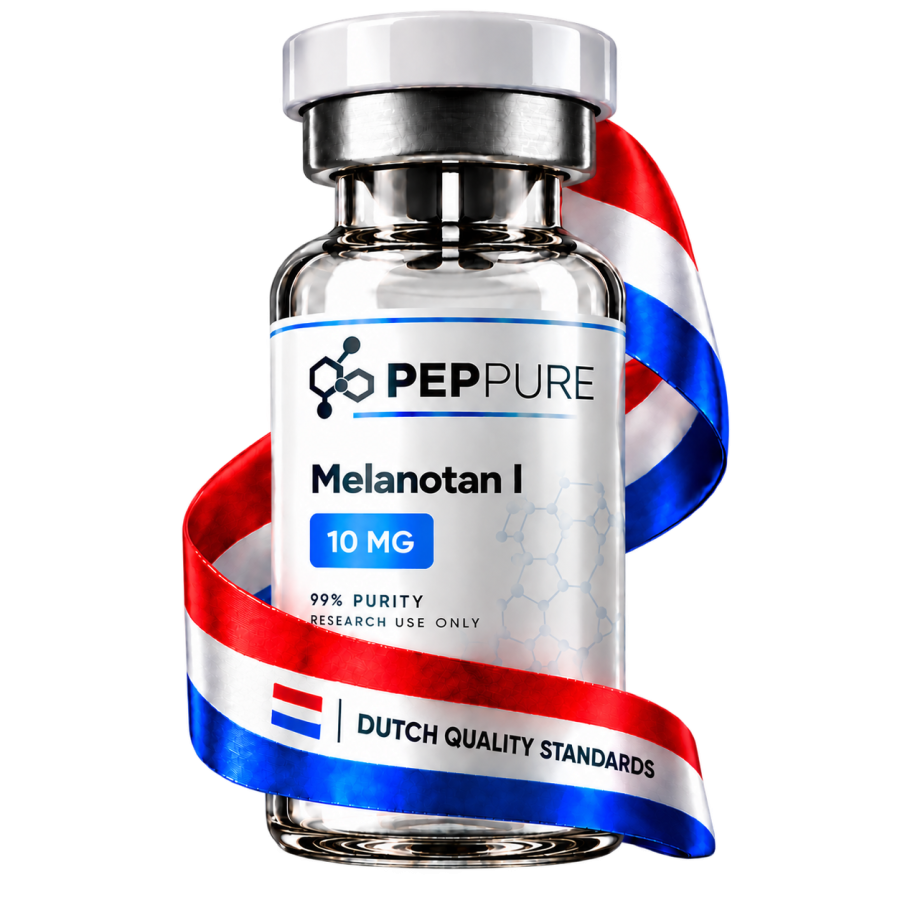
Melanotan I and Melanotan II sound like versions 1 and 2 of the same compound. In reality they are two different peptides, developed in the same lab in Arizona. Both stimulate pigment formation in the skin, but Melanotan II does a great deal more besides. That difference also explains why only one of the two has been approved as a medicine.
At a glance
| Melanotan I | Melanotan II | |
|---|---|---|
| Other name | Afamelanotide | MT-II |
| Structure | Linear, 13 amino acids | Cyclic, 7 amino acids |
| Molecular weight | 1646.8 g/mol | 1024.2 g/mol |
| Receptors | Mainly MC1R | MC1R, MC3R, MC4R (and MC5R) |
| Effects | Pigmentation | Pigmentation, appetite, sexual function |
| Status | Approved medicine (EPP, 2014) | Not approved anywhere |
The basis: α-MSH and the melanocortin receptors
Both peptides are derived from α-MSH (alpha-melanocyte-stimulating hormone), a 13-amino-acid hormone that the body produces itself. α-MSH acts via five melanocortin receptors, MC1R to MC5R, each with its own role:
- MC1R on pigment cells (melanocytes): production of dark pigment.
- MC3R and MC4R in the brain: appetite, energy balance and sexual function.
- MC2R in the adrenal gland (responds to ACTH, not to α-MSH) and MC5R in the sebaceous glands, among other places.
Natural α-MSH is broken down within minutes. In the 1980s, researchers at the University of Arizona therefore looked for more stable variants. That first produced Melanotan I and later Melanotan II [1], [2].
Melanotan I (afamelanotide)
Melanotan I is α-MSH with two modified amino acids: norleucine at position 4 and D-phenylalanine at position 7. The length of 13 amino acids stays the same. These two changes make the peptide much more stable and potent, while its preference for MC1R is largely retained.
After binding to MC1R, the signalling molecule cAMP rises in the pigment cell. Via the transcription factor MITF, genes for tyrosinase and related enzymes are switched on; these enzymes turn tyrosine into dark eumelanin. Eumelanin absorbs UV radiation and scavenges free radicals [3].
Under the name afamelanotide, Melanotan I was approved by the European Medicines Agency in 2014 as an implant for erythropoietic protoporphyria (EPP), a rare condition in which sunlight causes severe pain. In two controlled studies with 168 patients, participants on afamelanotide were able to spend longer in the sun without pain than those on placebo [4].
Melanotan II
Melanotan II is a smaller, cyclic peptide of 7 amino acids: Ac-Nle-cyclo[Asp-His-D-Phe-Arg-Trp-Lys]-NH2. Its ring structure makes it very stable and allows it to cross the blood-brain barrier. More importantly, it is far less selective: in addition to MC1R, Melanotan II also activates MC3R and MC4R in the brain.
As a result, it has effects that have nothing to do with pigment. In a small phase 1 study from 1996, researchers observed not only pigmentation but also nausea, reduced appetite and spontaneous erections [5]. That research later gave rise to bremelanotide, a closely related peptide approved in the US for low sexual desire in women. Melanotan II itself is not approved as a medicine anywhere.
The difference in one paragraph
Melanotan I is the selective variant: it acts mainly on the pigment receptor MC1R, is linear and, as afamelanotide, has been extensively studied in the clinic and approved. Melanotan II is the broad variant: cyclic, more potent and active at several receptors, with effects on appetite and sexual function, and without approval. For research that specifically aims to study the pigmentation pathway, Melanotan I is therefore the cleaner choice.
Warnings from regulators
Outside the lab, Melanotan is mainly sought after as a ‘tanning agent’. European regulators, including the UK’s MHRA, have warned against using unlicensed melanotan products for that purpose. Changes to moles, among other things, have been described in the medical literature. Afamelanotide itself may also only be used under medical supervision, for the condition for which it is approved.
Melanotan I for research
PepPure supplies only Melanotan I, as a 10 mg lyophilized powder with a certificate of analysis for each batch. The peptide is sensitive to light; how to store it is explained in Storage and stability of lyophilized peptides.
Sources
- Sawyer TK, Sanfilippo PJ, Hruby VJ, et al. 4-Norleucine, 7-D-phenylalanine-α-melanocyte-stimulating hormone: a highly potent α-melanotropin with ultralong biological activity. Proc Natl Acad Sci USA. 1980;77(10):5754–5758.
- Hadley ME, Dorr RT. Melanocortin peptide therapeutics: historical milestones, clinical studies and commercialization. Peptides. 2006;27(4):921–930.
- Minder EI, Barman-Aksözen J, Schneider-Yin X. Pharmacokinetics and Pharmacodynamics of Afamelanotide and its Clinical Use in Treatment of Dermatologic Disorders. Clin Pharmacokinet. 2017;56(8):815–823.
- Langendonk JG, Balwani M, Anderson KE, et al. Afamelanotide for Erythropoietic Protoporphyria. N Engl J Med. 2015;373(1):48–59.
- Dorr RT, Lines R, Levine N, et al. Evaluation of melanotan-II, a superpotent cyclic melanotropic peptide in a pilot phase-I clinical study. Life Sci. 1996;58(20):1777–1784.
Research Use Only. This article summarises published research and is not medical advice or advice on use. PepPure’s Melanotan I is intended exclusively for in-vitro research and laboratory use and is not a tanning agent.