You dissolve a lyophilized peptide before you work with it. How much water you use is up to you, but that choice determines the concentration of the solution. And you need that concentration to measure accurately. Fortunately, the calculation is simple.
The formula
The concentration is the amount of peptide divided by the amount of liquid:
concentration (mg/ml) = peptide in the vial (mg) ÷ water added (ml)
So a 10 mg vial to which you add 2 ml of water gives a solution of 5 mg/ml. Since 1 mg equals 1,000 micrograms (mcg), that is also 5,000 mcg/ml, or 500 mcg per 0.1 ml.
Calculation table
The concentration in mg/ml for common combinations:
| Peptide in vial | 1 ml water | 2 ml water | 3 ml water |
|---|---|---|---|
| 5 mg | 5 mg/ml | 2.5 mg/ml | 1.67 mg/ml |
| 10 mg | 10 mg/ml | 5 mg/ml | 3.33 mg/ml |
| 15 mg | 15 mg/ml | 7.5 mg/ml | 5 mg/ml |
| 20 mg | 20 mg/ml | 10 mg/ml | 6.67 mg/ml |
| 30 mg | 30 mg/ml | 15 mg/ml | 10 mg/ml |
How much water should you use?
There is no fixed rule; it depends on how precisely you need to measure. Two rules of thumb:
- More water gives a lower concentration. Each measured amount of liquid then contains less peptide, which makes it easier to measure small amounts accurately.
- Less water gives a higher concentration. Handy if you want to work with small volumes, but a small reading error then carries more weight.
Choose an amount that makes the maths easy. With 1, 2 or 5 ml you get round numbers; with 3 ml in a 10 mg vial you get 3.33 mg/ml, which is harder to measure. Always note on the vial how much water you added and on what date.
Why bacteriostatic water?
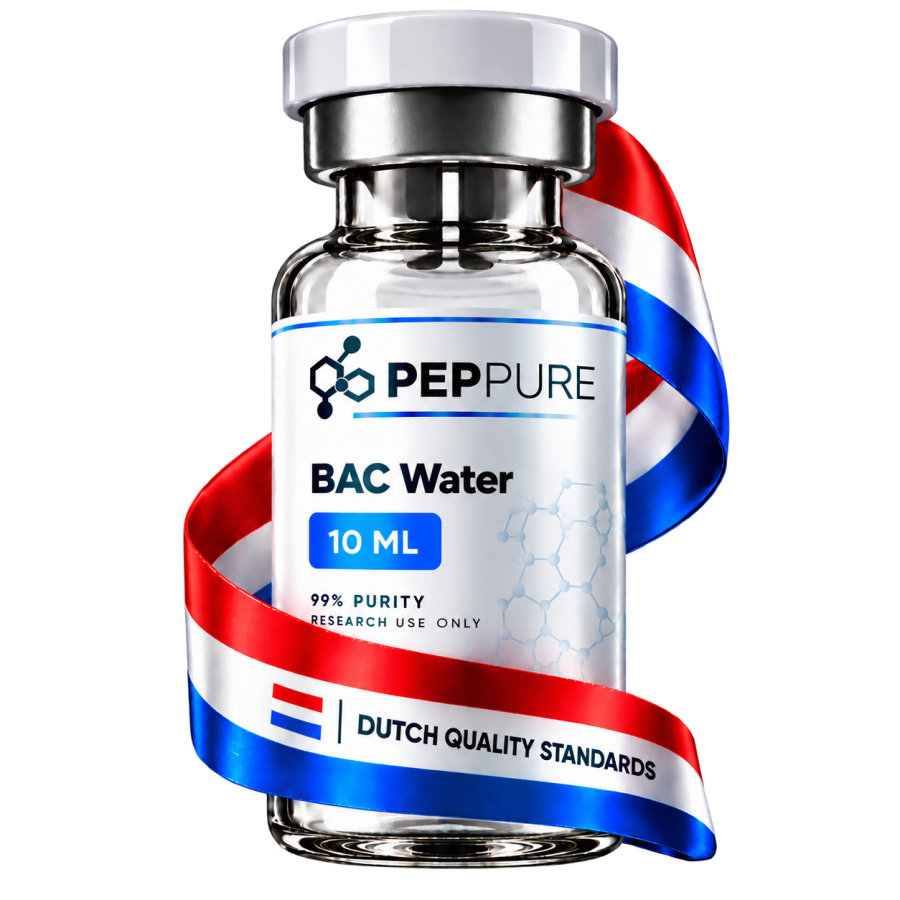
Bacteriostatic water is sterile water containing 0.9% benzyl alcohol. The benzyl alcohol inhibits bacterial growth, so you can puncture a vial several times without the solution quickly becoming contaminated. Plain sterile water lacks this protection and is therefore intended for single use.
At PepPure, every peptide in your order comes with 3 ml of bacteriostatic water free of charge. Larger 10 or 30 ml bottles can be ordered separately.
How to dissolve the peptide
- Let the vial come to room temperature and disinfect the rubber stopper with an alcohol wipe.
- Draw up the chosen amount of bacteriostatic water.
- Inject the water slowly down the inside wall of the vial, not directly onto the powder.
- Gently swirl the vial until the powder has fully dissolved. Do not shake it: this can damage the peptide.
- Check that the solution is clear. With GHK-Cu and blends containing it, a blue colour is normal.
The detailed steps and background can be found in Reconstitution: from lyophilizate to solution.
Storage after dissolving
A dissolved peptide is less stable than the dry powder. Store the solution in the fridge at 2–8 °C, protected from light, and use it within a few weeks. Do not repeatedly freeze and thaw a reconstituted vial. More in Storage and stability of lyophilized peptides.
Worked example: blends
With a blend, you first calculate the total concentration and then the share of each peptide. A vial of Glow contains 70 mg: 50 mg GHK-Cu, 10 mg BPC-157 and 10 mg TB-500. With 3.5 ml of water, the total concentration is 20 mg/ml. Of that, 5/7 is GHK-Cu (14.3 mg/ml) and 1/7 each is BPC-157 and TB-500 (2.9 mg/ml).
Research Use Only. This article describes laboratory procedures and calculations. It is not usage or dosing advice. PepPure’s peptides are intended exclusively for in-vitro research and laboratory use.