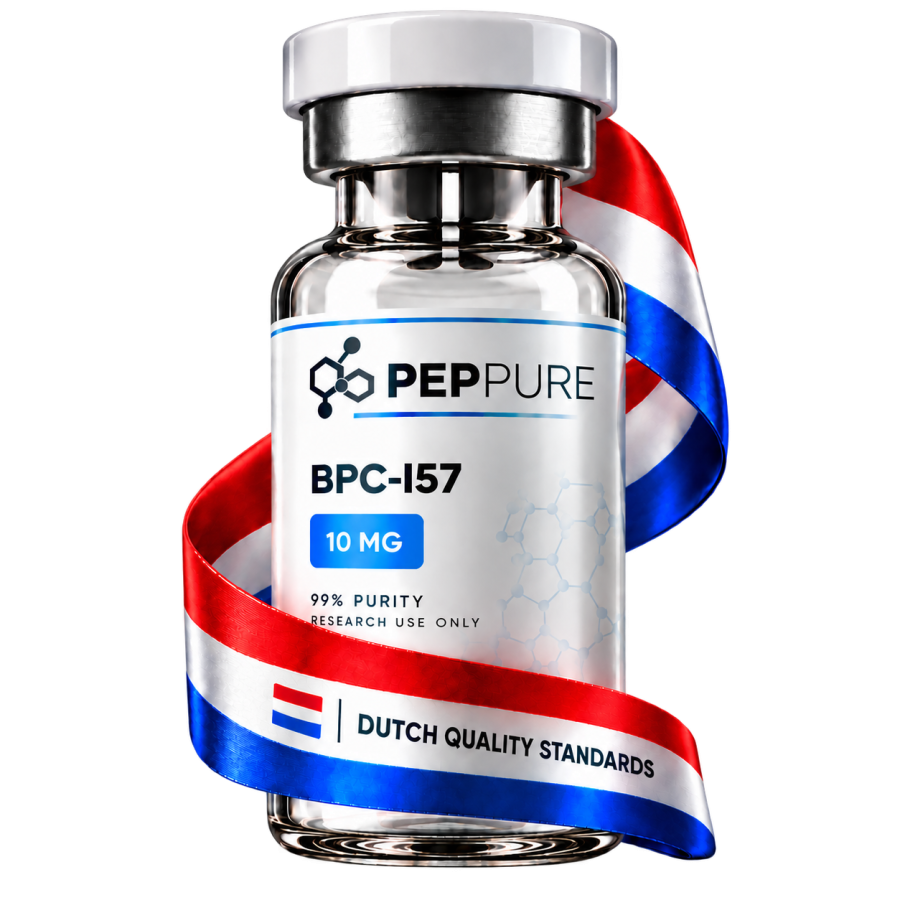
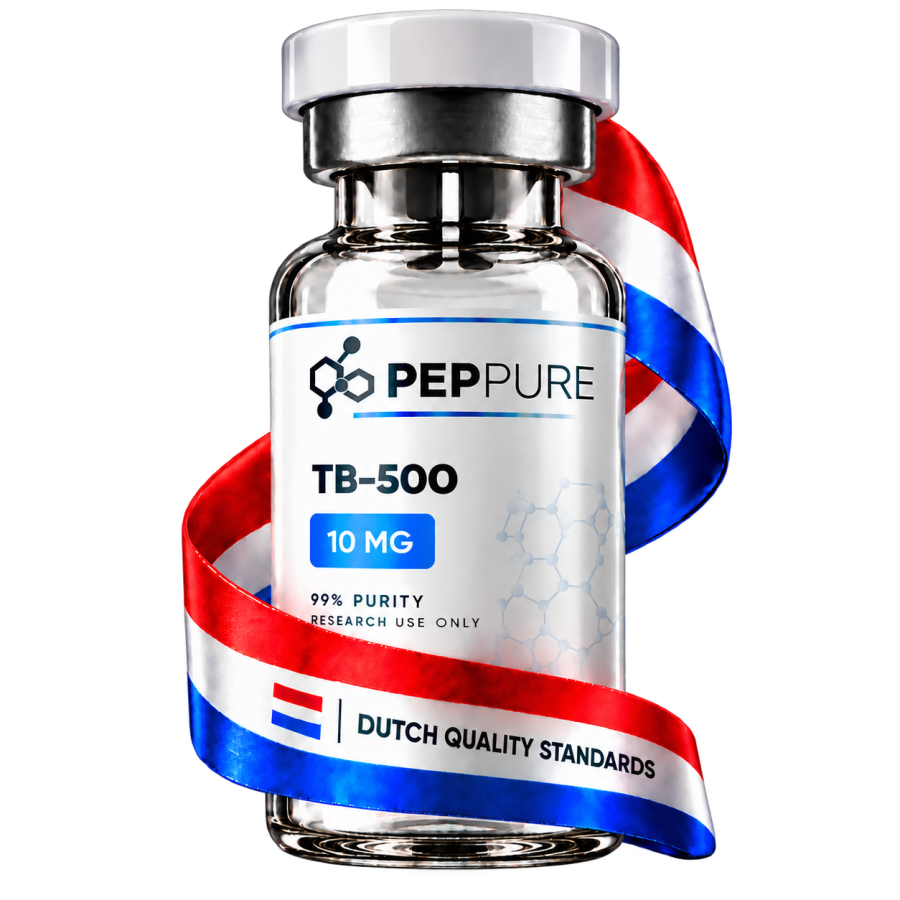
BPC-157 and TB-500 are the two peptides most often mentioned in tissue repair research. They are also frequently named together, as if they were variants of the same thing. They are not: they come from different sources, are built differently and act at different points in the repair process.
At a glance
| BPC-157 | TB-500 | |
|---|---|---|
| Derived from | Protective protein from gastric juice | Thymosin beta-4 (Tβ4) |
| Length | 15 amino acids | 43 amino acids (full Tβ4) |
| Molecular weight | 1419.5 g/mol | 4963.4 g/mol |
| Main pathway | Blood vessel formation (VEGFR2), FAK-paxillin, NO system | Actin binding, cell migration |
| Studied in | Tendons, ligaments, muscle, bone, gastrointestinal mucosa | Skin wounds, heart, cornea |
| Research in humans | Virtually none | Limited (eye, skin) |
| WADA Prohibited List | Yes | Yes |
What is BPC-157?
BPC-157 is a synthetic pentadecapeptide: a chain of 15 amino acids (Gly-Glu-Pro-Pro-Pro-Gly-Lys-Pro-Ala-Asp-Asp-Ala-Gly-Leu-Val). The sequence is derived from a protective protein found in human gastric juice; BPC stands for Body Protection Compound. It was described in the early 1990s by Predrag Sikirić’s group in Zagreb.
What makes BPC-157 unusual is that it remains stable in stomach acid. That is why animal studies have investigated it not only by injection but also orally.
What is TB-500?
TB-500 is the synthetic form of thymosin beta-4, a 43-amino-acid peptide found in almost all cells. It was isolated from the thymus in 1981, but turned out to play its main role in the cytoskeleton: it is the principal protein cells use to manage their pool of free actin.
Commercially, the name TB-500 is used both for the full peptide and for a short fragment. So always check the molecular weight on the certificate of analysis.
The mechanisms side by side
Tissue repair roughly proceeds in phases: inflammation, the build-up of new tissue with blood vessels, and then remodelling into strong, organised tissue. The two peptides act at different points.
BPC-157: blood supply and signalling pathways
- In cell studies, increases the expression and activation of VEGFR2, the receptor for the growth factor VEGF. This promotes the formation of new small blood vessels [1].
- Activates the FAK-paxillin pathway in tendon fibroblasts, which controls cell adhesion and migration [2].
- Increases the number of growth hormone receptors in tendon fibroblasts and influences the nitric oxide system [3].
TB-500: the cytoskeleton and cell movement
- Binds free actin (G-actin) and so determines how quickly cells can remodel their skeleton in order to move. The actin-binding region lies around the sequence LKKTETQ [4].
- Promotes the migration of skin cells and endothelial cells into a wound [5].
- Helps cells survive under stress via the enzyme ILK and the Akt pathway; in animal models this includes heart muscle cells after an infarction [6].
In short: BPC-157 acts mainly on the wound’s environment (blood flow, signals), TB-500 mainly on the cells themselves (movement, survival).
Why they are often studied together
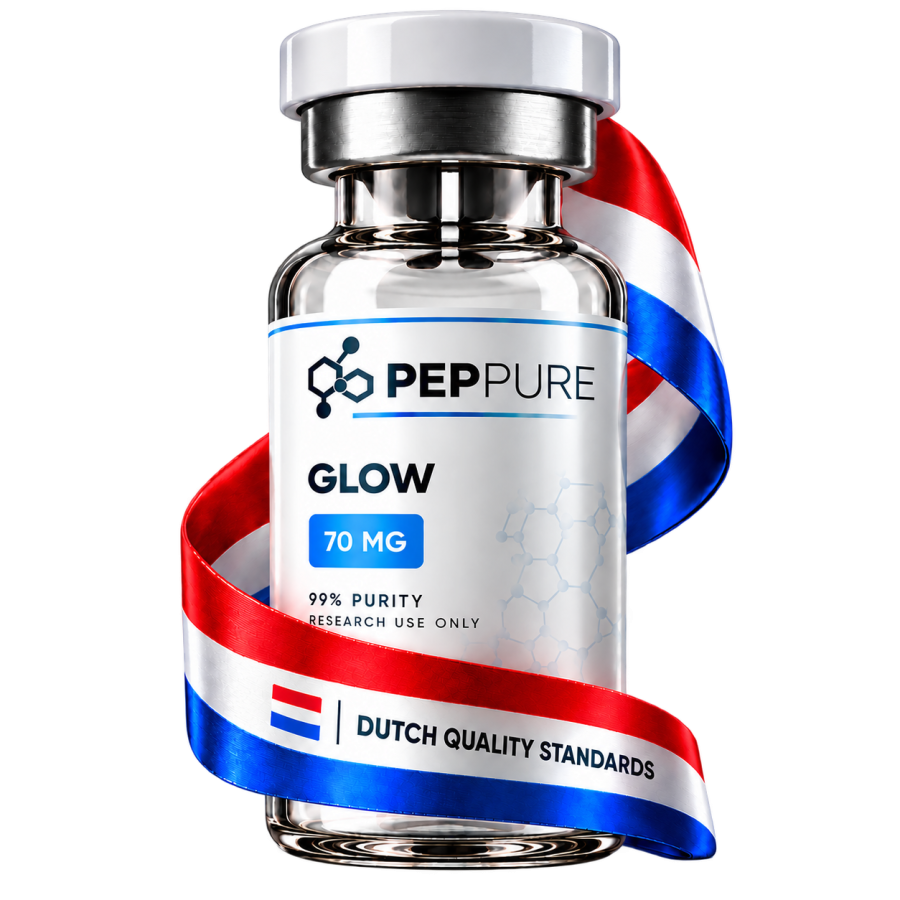
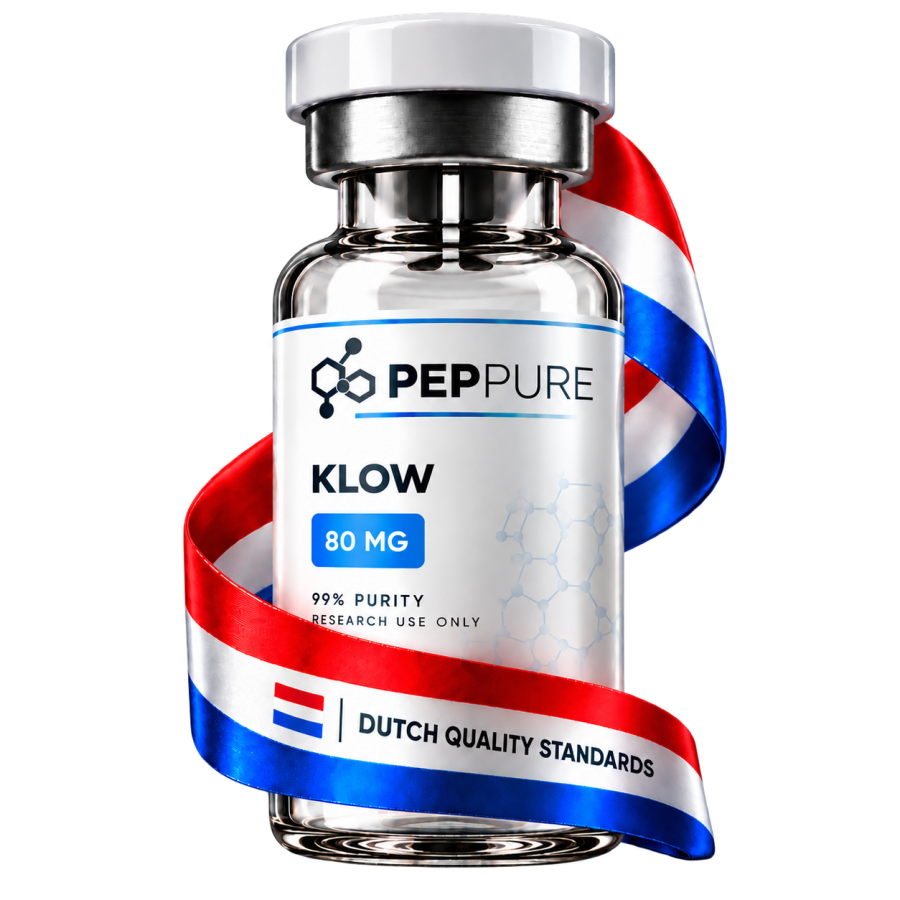
Because they act at different steps, the idea is that they complement each other. That explains the popularity of blends. Glow contains BPC-157 and TB-500 together with GHK-Cu, which stimulates collagen production. Klow adds KPV, a tripeptide being studied for its anti-inflammatory activity.
Worth knowing: the combination itself has not been investigated in published clinical studies. The rationale comes from research on the individual peptides.
The state of the research
For both peptides, most of the evidence is preclinical: cell cultures and laboratory animals. With BPC-157, most publications also come from a single research group, which makes independent confirmation all the more important. Thymosin beta-4 has been studied in humans, but only for specific applications such as eye drops for corneal disorders and a gel for poorly healing skin wounds. For other applications, safety and efficacy in humans have not been established.
Which one should you choose for your research?
- Research into blood vessel formation, tendons or gastrointestinal mucosa: BPC-157.
- Research into cell migration, actin or wound closure: TB-500.
- Research into the combination in a fixed ratio: Glow or Klow.
How to dissolve and store the peptides is explained in Reconstitution: from lyophilizate to solution.
Sources
- Hsieh MJ, Liu HT, Wang CN, et al. Therapeutic potential of pro-angiogenic BPC157 is associated with VEGFR2 activation and up-regulation. J Mol Med. 2017;95(3):323–333.
- Chang CH, Tsai WC, Lin MS, Hsu YH, Pang JH. The promoting effect of pentadecapeptide BPC 157 on tendon healing involves tendon outgrowth, cell survival, and cell migration. J Appl Physiol. 2011;110(3):774–780.
- Seiwerth S, Rucman R, Turkovic B, et al. BPC 157 and Standard Angiogenic Growth Factors. Gastrointestinal Tract Healing, Lessons from Tendon, Ligament, Muscle and Bone Healing. Curr Pharm Des. 2018;24(18):1972–1989.
- Goldstein AL, Hannappel E, Sosne G, Kleinman HK. Thymosin β4: a multi-functional regenerative peptide. Basic properties and clinical applications. Expert Opin Biol Ther. 2012;12(1):37–51.
- Malinda KM, Sidhu GS, Mani H, et al. Thymosin β4 accelerates wound healing. J Invest Dermatol. 1999;113(3):364–368.
- Bock-Marquette I, Saxena A, White MD, DiMaio JM, Srivastava D. Thymosin β4 activates integrin-linked kinase and promotes cardiac cell migration, survival and cardiac repair. Nature. 2004;432(7016):466–472.
Research Use Only. This article summarises published research and is not medical advice or advice on use. PepPure’s peptides are intended exclusively for in-vitro research and laboratory use.